Understanding who our students are—their lives, motivations, and challenges—is the foundation of every design decision we make. This page explains who our students are and why it matters for how the course is built.
Our Students Are Adults with Full Lives
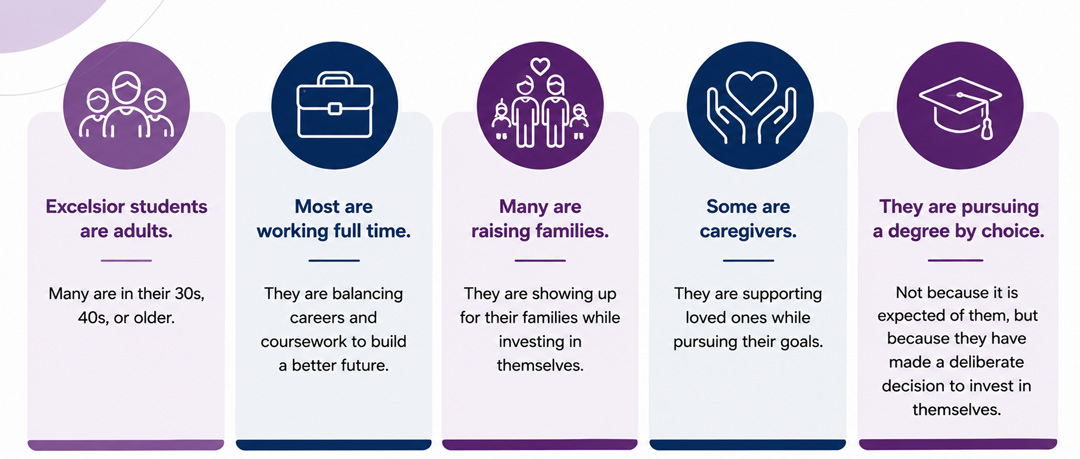
This has direct implications for how courses should be designed. Adult learners—a field of study with decades of research behind it—learn differently from traditional-age students. They bring substantial life and professional experience to their learning. They are motivated by relevance: they want to know why something matters and how it connects to their work or their goals. They are self-directed and goal-oriented. And they are time-constrained in ways that traditional students are not.
Understanding who our students are—their lives, motivations, and challenges—is the foundation of every design decision we make. This page explains who our students are and why it matters for how the course is built.
What this means for course design:
Connect Learning to the Real World
Relevance is essential. Every assignment, discussion, and piece of content should have a clear connection to something students can use in the real world.
Apply Theory Through Practice
Theoretical content should be anchored in application.
Use Authentic Contexts
Students should be able to see themselves in the examples, scenarios, and contexts the course uses.
Design Authentic Assessments
Abstract or purely academic framing will feel disconnected from their lives and reduce engagement. This is why our assessments are designed to reflect authentic professional tasks rather than traditional academic exercises.
Our Students Are Diverse in Experience and Background
Our student population spans an unusually wide range. In the same course section, you may have a student who is the first in their family to attend college sitting alongside someone completing a graduate degree after a 20-year career. Some students arrive with deep professional expertise in the subject area the course covers; others are encountering the content for the first time. Some are highly confident academic writers; others have not been in a classroom—physical or virtual—in years.
This diversity is a strength of our learning environment, but it requires courses to be designed without assumptions about what students already know or how comfortable they are with academic conventions. It also means that the life and professional experience students bring is not incidental—it is a genuine learning resource. Courses that invite students to draw on their own experience, connect new concepts to what they already know, and share perspectives from their professional contexts will be richer and more effective than courses that treat students as blank slates.
What this means for course design:
Avoid Assumptions About Experience
We cannot write course content or assessments assuming a specific level of prior academic experience.
Explain Academic Conventions
All jargon and academic conventions should be explained, with content scaffolded to build on prior knowledge.
Leverage Students’ Experience
Design assignments that make room for students to bring their own professional and personal experience into the work.
Use Inclusive, Relevant Examples
Be thoughtful about examples and scenarios. They should reflect the range of professional contexts and backgrounds students may come from, rather than assume a single industry or career path.
Our Students Choose Online, Asynchronous for a Reason
Our students are not taking online courses because they could not get into a traditional program. They are here because online, asynchronous learning fits their lives in a way that nothing else does. It lets them study at 10pm after the kids are in bed, complete work during a lunch break, or fit coursework around a rotating shift schedule. The flexibility of asynchronous learning is the point.
This means that courses need to be designed to stand on their own. There is no lecture to fill in the gaps, no office hours where a student can quickly ask for clarification, and no in-class discussion that resolves an ambiguous assignment prompt. Everything a student needs to succeed must be present in the course itself—in the content, the instructions, and the feedback mechanisms built into the design.
What this means for course design:
Prioritize Clarity
Clarity is non-negotiable. Assignment instructions, rubrics, and expectations must be complete and unambiguous because students may encounter them at midnight with no one to ask.
Design for Independent Navigation
Content should be designed to be navigable and meaningful without a live instructor walking students through it.
Use Feedback as a Learning Tool
Feedback from rubrics, discussion prompts, and auto-graded item explanations is the primary mechanism by which students learn from their work, and it should be designed accordingly.
Do Not Rely on Instructor Explanation
The assumption that “the instructor will explain this in class” does not apply here.
Key Takeaway
Our goal is to make our courses fair, relevant, and accessible to the people who will take them—adults with expertise, ambition, real constraints, and a genuine investment in what they are learning.